Log in
Loan Agreement
 Create a document
 PDF
PDF Word
Word ODT
ODT
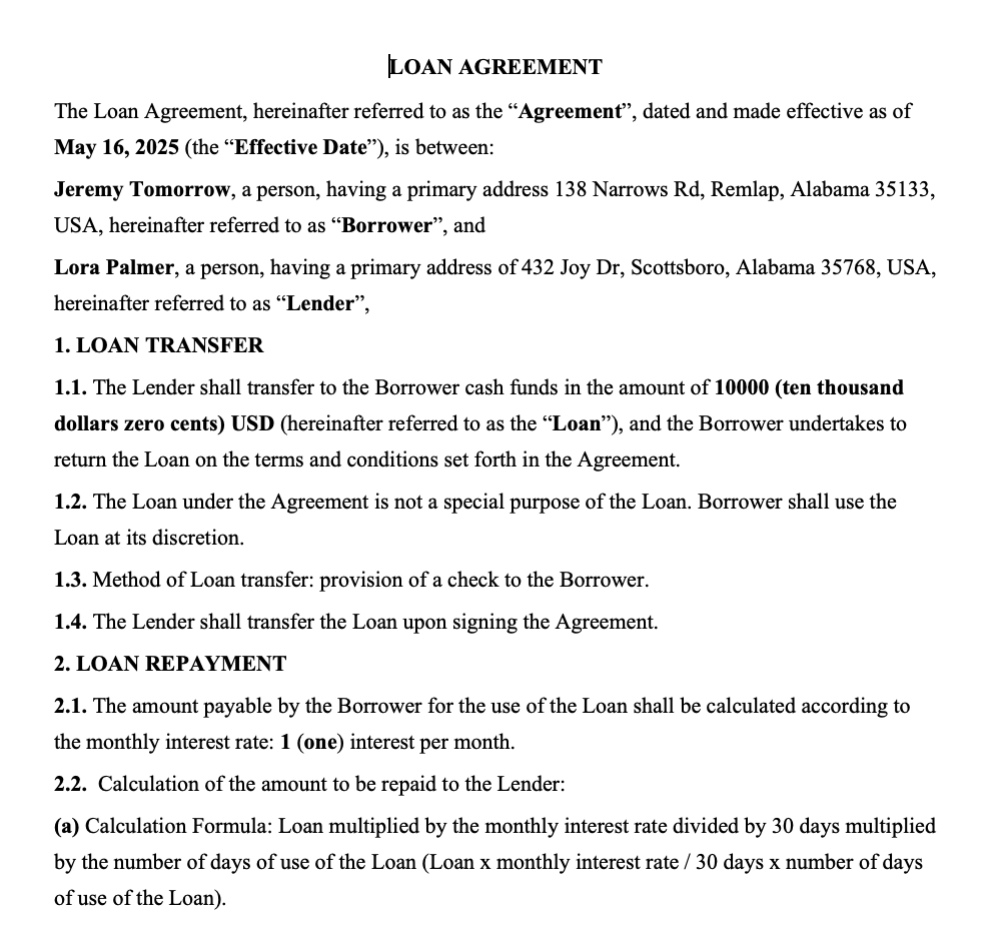
A Loan Agreement is a standard contract between a lender and a borrower, setting out the principal, interest rate, repayment schedule, and any collateral.
It can appear in personal or business contexts, and typically includes default clauses to protect the lender if the borrower fails to pay.
Many find it helpful to include the exact timeline, late fees, or grace periods, so each side knows the steps for monthly or quarterly payments.
Sometimes, a Loan Agreement covers large sums, so more robust clauses—like mandatory insurance on collateral—may appear.
Clarity on how interest is computed (simple or compounded) spares future uncertainty.
Storing a signed, printable copy ensures each party retains evidence, bolstering legal recourse if needed.
When two business entities or corporate parties enter a debt arrangement, a Loan Agreement Between Legal Entities arises.
Such a contract often features specialized covenants (like maintaining a certain debt-to-equity ratio or financial reporting obligations), as well as references to corporate resolutions authorizing the loan.
Because sums can be large, it may detail cross-default triggers, ensuring that if the borrower breaches another loan, this agreement also accelerates.
These deals typically revolve around more formal processes, such as board approvals or commercial lien filings.
Ensuring each entity’s signatory has proper authority is crucial, preventing claims of unauthorized borrowing or lending.
By elaborating on these elements, the agreement remains enforceable and transparent, even in multi-entity setups or cross-state transactions.
A Family Loan Agreement formalizes loans between relatives, reducing the risk of souring relationships over money.
Without a written contract, misunderstandings about repayment schedules or interest easily emerge, leading to personal tension.
By carefully stating principal, interest (if any), and due dates, each side retains peace of mind.
Some families prefer zero interest or flexible payoff timelines, but U.S. law might label extremely low rates as gifts, triggering gift tax considerations.
Hence, disclosing a modest interest rate often helps demonstrate a legitimate loan, safeguarding compliance.
A well-structured arrangement might also indicate if a default would let the lender reclaim personal items or offset future inheritance.
A Promissory Note is a concise document where the maker promises to repay a specific sum to the payee.
Unlike a full Loan Agreement, it often omits broader clauses about the borrower’s duties, focusing on principal, interest, and maturity date.
Such notes appear in personal loans, short-term financing, or bridging scenarios where the lender requires quick acknowledgment of debt.
Though relatively brief, a promissory note remains enforceable under U.S. law if it properly names parties, amount, and repayment.
Some also incorporate a simple reference to interest rate or default penalties, though in less detail than a standard contract.
Notarization, while not always mandatory, can strengthen the note’s validity if courts require proof of authenticity.
A Personal Loan Agreement is specifically tailored for non-business, informal loans among individuals.
It often resembles a simplified version of a Loan Agreement, detailing principal, interest (if any), repayment milestones, and default cures.
Many adopt plain language, so each side understands obligations, preserving personal relationships while safeguarding the lender.
Some personal deals are small or interest-free, but writing everything down ensures no confusion if the borrower takes longer to repay than expected.
Both parties usually sign, with optional witnesses or a notary for added security.
A personal arrangement can remain friendly but still respect legal formalities to uphold the lender’s and borrower’s best interests.
A Loan Personal Guarantee commits a third-party individual (the guarantor) to repay the debt if the primary borrower defaults.
Banks or private lenders often demand this for larger or riskier loans, or when the borrower lacks robust credit or collateral.
By signing, the guarantor pledges personal assets, giving lenders greater confidence in being repaid.
These agreements generally reference the main loan’s terms, ensuring the guarantor understands they inherit similar obligations on principal, interest, and fees.
Some disclaim the guarantor’s liability limit, while others keep it fully open.
Enforceability typically demands clarity in the text, linking it firmly to the underlying loan documents.

Page content

1. Clarity of Terms and Parties
All these loan agreements revolve around specifying who is involved, how much is lent, and how repayment occurs. Ensuring each name, address, and role is correct prevents claims of mistaken identity or confusion about signing authority. A single error in naming the borrower or lender can jeopardize enforcement if courts find the document ambiguous.
Even in family settings, referencing the correct full names fosters professional clarity, reinforcing that the contract remains legally valid. In corporate deals, verifying signatory authority is even more critical to avoid disputes over unauthorized borrowing. Well-defined roles keep each participant’s duties and obligations visible.
2. Defining Principal, Interest, and Payment Schedules
Central to any loan document is the principal sum, the interest rate, and how installments proceed. A mismatch between verbally stated sums and written figures might lead to disputes or partial invalidation. Specifying interest—whether zero, fixed, or variable—spares confusion and adheres to U.S. state usury laws.
A structured timetable for payments can appear in a table or bullet list, letting both parties easily track progress. If prepayment is allowed or late payment leads to penalties, noting these details protects the lender from indefinite delays or partial uncertainty.
3. Collateral and Security Interests
Sometimes the lender demands collateral or a personal guarantee. An unsecured deal might rely purely on trust or the borrower’s credit, but large sums often require tangible assurance. A properly described asset, or a personal guarantor, ensures the lender can recover if default arises, lowering risk.
Though family or personal loans often skip security, they might add a personal guarantee. If you do incorporate property, confirm alignment with local property and lien filing rules, ensuring no conflict or hidden claims. Such precautions raise the chance of recouping the debt if the borrower becomes uncooperative.
4. Default and Remedies
Each contract typically spells out events of default, like missed installments, insolvency, or covenant breaches. Once default is triggered, the lender may accelerate the debt, seeking immediate full repayment. Alternatively, some contracts offer a grace period or partial cure rights, letting the borrower rectify the issue.
Remedies also include charging default interest or collecting legal expenses. In a personal or family scenario, a gentle approach might be used, but specifying it still helps avoid misunderstandings. Clear default terms also help courts see that the contract was thorough, increasing the lender’s likelihood of success if litigation happens.
5. Governing Law and Dispute Resolution
Loan agreements usually name a state or jurisdiction’s laws to guide enforcement. When parties live in different states, picking a single forum saves the lender from chasing borrowers across multiple courts. Arbitration can appear if both sides prefer confidentiality and faster resolution.
If you’re drafting, ensure local consumer finance or personal property rules do not override your chosen approach. For instance, in family or small personal deals, local courts might remain simpler than specialized arbitration. Nonetheless, specifying the forum cements clarity, helping everyone see how conflicts are resolved.
6. The Signatures, Witnessing, and Storage
After finalizing the text, all relevant parties sign and date the contract. A witness or notary can strengthen authenticity, though not always mandated. Retaining the final doc—digitally or physically—facilitates quick reference if the borrower or lender forgets exact terms.
In corporate or entity-based loans, a board resolution or managing partner signature might be required. Promissory notes, personal loans, or family deals might keep it simpler but still must confirm each signatory’s understanding. Proper archiving is vital if disputes later require proof of the contract’s existence or content.
7. Amendments and Flexibility
Circumstances shift, so a borrower may request extended deadlines or a changed interest rate. Amendment clauses in the contract define how modifications happen: typically requiring a short written addendum, co-signed by lender and borrower. By making it official, you prevent verbal claims that the lender or borrower verbally agreed to more time.
In family or personal deals, gentle adjustments might be made informally. But if the sum is large or there’s strong potential for friction, sticking to a formal addendum process fosters consistent compliance with legal standards.
8. Impact of Local and Federal Laws
Different U.S. states impose caps on interest (usury statutes) or require precise disclosures for consumer loans. Ignoring these can lead to partial or total invalidation of interest or even the entire contract. Further, some states treat zero-interest family loans as potential gifts, with tax consequences if large sums pass between relatives.
On the federal side, certain laws like the Truth in Lending Act might apply if the deal is a consumer loan with a high principal or repeated transactions. Hence, ensuring compliance with required disclosures or timing is critical for validity. Legal counsel can assist in verifying that your contract meets these statutory demands.
9. Maintaining Relationships and Professionalism
Even the most thorough contract cannot replace good faith and open communication. Family or personal loans can become emotionally charged, so clarity fosters trust and spares relationships from resentment. In corporate or formal deals, well-defined obligations let each side operate confidently, free from suspicion of hidden terms.
Check in periodically with the borrower if installments are due, ensuring no misinterpretation of due dates or partial payments. When the loan is fully settled, a short “paid in full” letter or release cements final closure. Following best practices at every step, from drafting to final payoff, upholds fairness and maintains the essence of these loan agreements under U.S. law.


 Select a plan