Log in
Independent Contractor Agreement (ICA)
 Create a document
 PDF
PDF Word
Word ODT
ODT
A Subcontractor Agreement comes into play when a prime contractor transfers parts of a project’s tasks to a third-party specialist. It is common in construction, consulting, or large-scale service projects.
This agreement clarifies the subcontractor’s scope, timelines, pay structure, and default remedies, ensuring the prime contractor retains overarching responsibility to the end client. In short, it delineates how subcontractors perform tasks while reporting to the prime contractor, not the main client directly.
By incorporating clauses on deliverables, quality standards, liability, and confidentiality, a Subcontractor Agreement protects project continuity. It avoids confusion about who bears responsibility for any failures and how disputes are resolved.
A Service Agreement is a general contract between a service provider and a recipient, defining the tasks, deadlines, and payment terms. It applies across numerous fields, from marketing campaigns to property maintenance or technical support.
In essence, the provider agrees to perform certain duties in exchange for compensation. Meanwhile, the client consents to pay for those services and provide any necessary materials or data.
Crucial elements include specifying deliverables, acceptance criteria, rates, late fees, intellectual property ownership, and confidentiality. Tailoring a Service Agreement to the unique nature of the tasks ensures smooth collaboration and reduces the risk of payment or performance disputes.
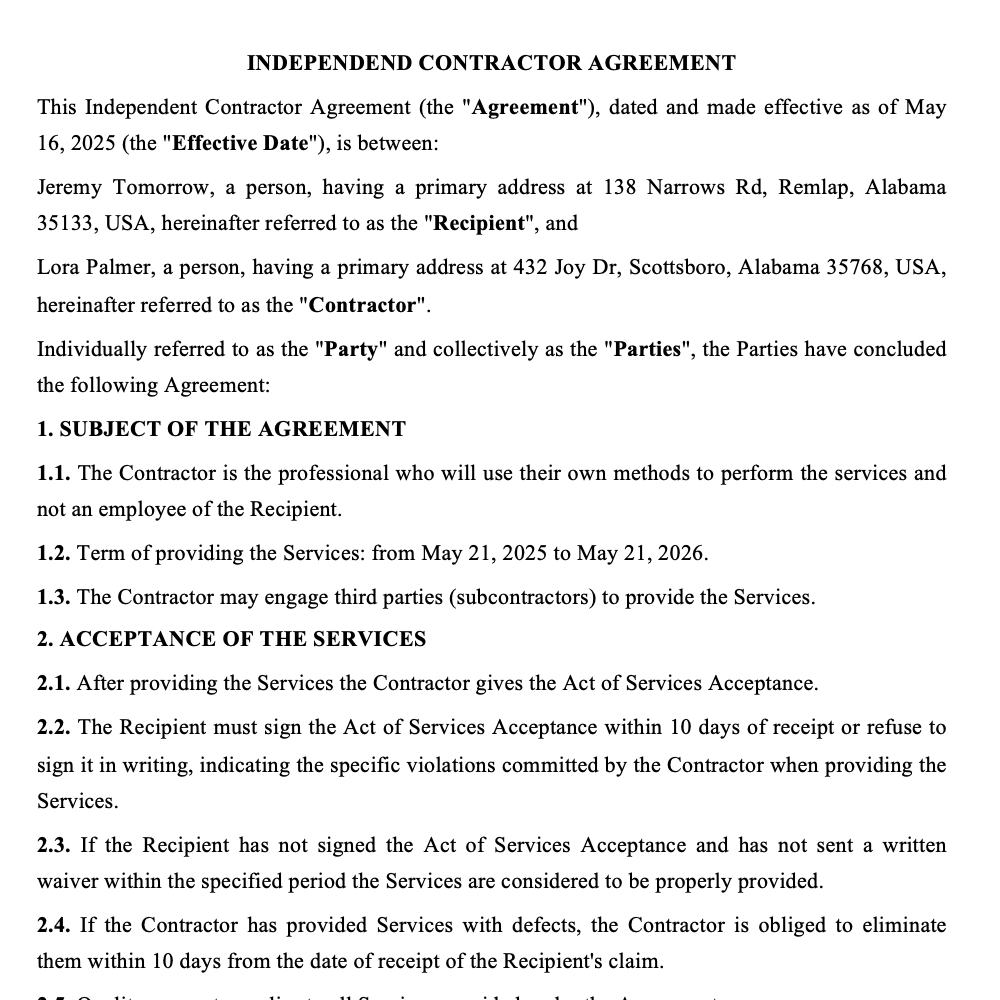
An Independent Contractor Agreement differentiates a contractor’s role from that of an employee. Under such arrangements, the contractor controls how and when to accomplish tasks, bearing responsibility for taxes and benefits.
Businesses often use these contracts when hiring external specialists or project-based workers. Clear disclaimers about “non-employee status” help avoid misclassification under labor laws.
This agreement typically covers the scope of work, compensation, timelines, and confidentiality obligations. Many also include disclaimers that no permanent position is implied, ensuring both sides remain free to terminate the relationship once the project ends or deliverables are fulfilled.
A Web Development Agreement addresses custom software or website creation. It usually states the developer’s responsibilities, from coding to designing, as well as the client’s obligations, like providing assets or offering timely feedback.
Key sections outline scope of features, milestone deliveries, revisions, acceptance tests, hosting details, and ongoing maintenance. The contract might also detail intellectual property rights to code or design.
By specifying these points, both developer and client reduce misunderstandings about project scope, deadlines, cost, or ownership. Many rely on a standard approach to payment and revision processes, ensuring that the final product meets the client’s expectations.
A Freelance Contract is designed for individuals who offer specialized services on a project or hourly basis. This agreement outlines the freelancer’s scope, compensation, deadlines, and revision allowances.
It can include clauses such as late fees, intellectual property transfer, and non-disclosure, depending on the job’s complexity. Both the hiring party and the freelancer benefit from clarifying payment schedules, rights to final deliverables, and acceptable uses of any proprietary tools.
Setting a well-defined structure with a Freelance Contract helps maintain a healthy balance between creative freedom and business expectations. It often includes disclaimers ensuring the freelancer remains an independent contractor, not an employee.
A Consulting Agreement involves a professional consultant who delivers advice, recommendations, or analysis. Common across many industries, consulting covers strategic planning, financial guidance, or technical evaluations.
The agreement addresses scope of analysis, confidentiality regarding trade secrets, and disclaimers about the consultant not guaranteeing specific results. Payment might be fixed-fee or retainer-based, with potential performance bonuses.
Because consulting can influence major decisions, disclaimers clarifying the consultant’s limited liability are important. This ensures the client acknowledges the consultant’s role is advisory and that ultimate decisions rest with the business.
A Statement of Work is not a standalone contract but a detailed addendum or supplement describing each deliverable, milestone, or phase in a service-based project. It often pairs with a main contract, such as a Service Agreement, specifying the exact tasks and deadlines.
The SOW normally includes a step-by-step breakdown, acceptance criteria, and cost estimates for each stage. By clarifying each micro-task, both provider and client can track progress.
This approach prevents disputes about whether certain activities were included in the initial cost or timeline. Integrating the SOW into broader contractual frameworks helps align technical specifics with overarching legal obligations.
An Act of Services Acceptance is a short certificate or document confirming that the client approves the deliverables as meeting agreed standards. Often used after a milestone or final completion, this acceptance triggers payment obligations.
Some treat it as a “sign-off” on the project, acknowledging that the services are rendered satisfactorily. Disagreements about minor issues typically surface before signing. Once the acceptance is signed, it becomes hard to claim the deliverables were subpar.
By systematically using this acceptance form, businesses create a record that tasks were properly performed. This fosters clarity if the client later tries to allege incomplete or defective work.

Page content

1. Introduction
Business transactions often rely on formal agreements that clearly define responsibilities, payment terms, deliverables, and recourse in case of disputes. Over time, different types of contracts have evolved, each meeting unique needs in various sectors.
2. Comparing These Agreements
All eight agreements revolve around defining responsibilities and reducing misunderstandings in professional or contractual relationships. Some, like the Subcontractor Agreement or Web Development Agreement, focus heavily on project deliverables. Others, such as the Freelance Contract or Consulting Agreement, may revolve around intangible work.
A Statement of Work offers granular detail. Meanwhile, an Act of Services Acceptance offers closure once tasks are done. The common thread among them is setting roles, tasks, fees, timelines, and liability disclaimers to ensure legal enforceability.
Ultimately, each addresses unique contexts. But the essence remains: each party should understand what they promise, what they owe, and how disputes resolve.
3. Legal Enforceability
All these documents must follow local regulations. For instance, labor laws might influence whether a Freelance Contract is valid or if the worker is misclassified. Similarly, a Web Development Agreement might involve consumer protection if the client is not a business.
Terms about liability or disclaimers must align with mandatory rules that no contract can override. Court acceptance of e-signatures or notary requirements might also apply, depending on region.
Double-checking with a legal adviser is wise, especially if large sums or long-term commitments are involved. A robust contract that meets local formalities stands a higher chance of enforcement.
4. Importance of Customization
Though many rely on an online sample or a form template, each contract should be tailored. Scope, timelines, and payment differ widely even for similar jobs. For instance, one Web Development Agreement might revolve around a small landing page, while another builds an entire e-commerce platform.
Similarly, an Independent Contractor Agreement must reflect specific tasks, schedules, or deliverables. Overly generic language can create gaps that lead to confusion. By customizing thoroughly, both sides know exactly what they sign. This clarity fosters trust and reduces friction during execution.
5. Finalizing and Storing Documents
Once the contract or agreement is drafted, each party should sign, possibly with witness or notary if local law requires it. Then keep a copy in a safe place, whether physically or digitally.
In large organizations, a standardized approach might store these agreements on a central server. Smaller outfits might prefer a simple folder or a dedicated drive. The point is having easy access if future disagreements arise about scope or obligations.
When dealing with an Act of Services Acceptance or a Statement of Work, ensure they remain attached to or cross-referenced with the main agreement. This unified approach prevents accidental separation or misplacement.
6. Potential Pitfalls
Some common pitfalls include failing to mention each relevant detail, leaving the door open to conflicting interpretations. Another hazard is not updating the contract when project scope shifts.
If compensation structures, deadlines, or tasks evolve but remain unmodified in writing, future disputes become more likely. Also, ignoring local regulations about working hours, liability caps, or IP ownership can lead to partial or full invalidation of the agreement.
Being thorough and consistent in each clause is key. Even a small oversight can yield big headaches if payment or project quality is at stake.
7. Conclusion
Across many business and professional contexts, these eight agreements serve a vital role. A Subcontractor Agreement clarifies tasks delegated by prime contractors. A Service Agreement sets the framework for intangible or ongoing tasks. Independent Contractor Agreements ensure non-employee status. Web Development Agreements target site-building tasks. Freelance Contracts shape project-based creative or technical gigs.
Consulting Agreements define the scope and limits of advisory roles. A Statement of Work offers detailed breakdowns of deliverables. Meanwhile, an Act of Services Acceptance finalizes task completion.
Together, these contracts and forms anchor modern commerce, providing security, clarity, and a roadmap for successful collaboration. By referencing them properly, customizing each for the given scenario, and ensuring sign-off at key stages, businesses minimize conflict and uphold professional standards.


 Select a plan