Log in
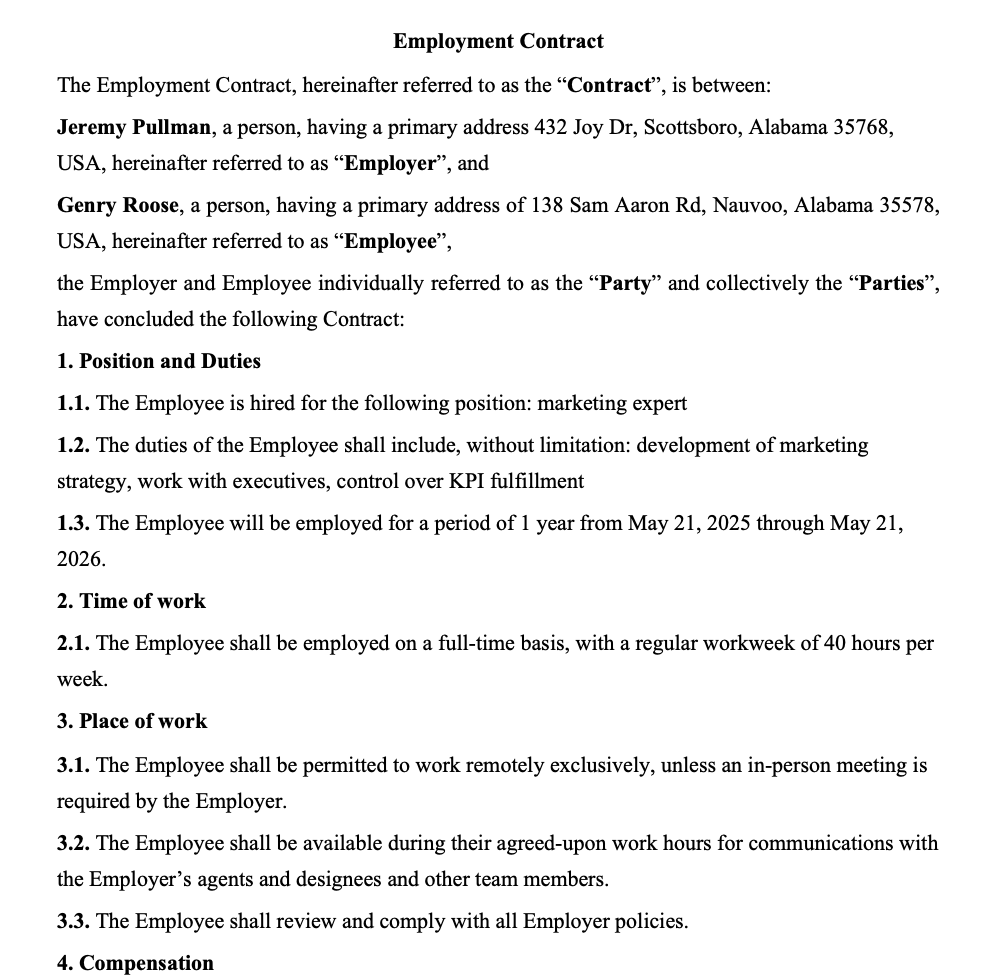
Employment Contract
 Create a document
 PDF
PDF Word
Word ODT
ODT
An Employment Contract is the foundational agreement binding an employee and employer. It outlines key terms such as position, salary, responsibilities, benefits, and how the job can end. By documenting these elements, both sides reduce confusion on pay, duties, or any special perks.
This contract often includes disclaimers on trade secrets or intellectual property.
Many employers prefer written contracts for high-level or specialized roles, ensuring clarity and legal security.
Though some regions permit at-will hiring, a formal Employment Contract remains valuable if the company offers extended job guarantees or severance terms.
The At-Will Employment Agreement sets an employee’s position on a flexible basis, allowing either side to end the relationship at any time without cause or prior notice.
Such arrangements are widespread in numerous U.S. states, but they still respect anti-discrimination laws and public policy exceptions.
Adopting an at-will approach typically involves disclaimers stating that no spoken or implied promises override at-will status.
This agreement may cover basic duties, wages, and standard policies while reiterating that no guaranteed term exists.
It emphasizes the employer’s right to alter job terms, wages, or responsibilities without forming a permanent contract.
Nevertheless, an At-Will Employment Agreement must remain lawful, forbidding firing for illegal reasons like race or whistleblower activities.
A Remote Work Policy regulates staff operating offsite, whether full-time or part-time.
It typically covers eligibility, expected working hours, communication tools, and how performance is monitored.
Security measures for handling company data from home often appear, ensuring compliance with confidentiality and tech standards.
Such policies help employees balance autonomy with accountability.
They highlight expense reimbursements or any stipend for home office supplies.
If management can revoke remote status, the policy clarifies that as well, preserving the company’s flexibility to change operational methods.
An Employee Privacy Policy informs staff about what personal data the employer collects, stores, and shares.
It might detail normal HR records like addresses, health info, or performance reviews.
Additionally, it could reference any monitoring of emails, devices, or usage logs.
By explaining data protection measures, the company fosters trust and compliance with privacy laws.
Some policies offer employees the right to request corrections or see certain data.
Ensuring alignment with local labor and data-protection statutes is crucial to make the policy valid and transparent.
A Non-Compete Agreement bars employees or contractors from joining or starting rival businesses for a period after leaving.
It protects trade secrets, client relationships, and proprietary methods.
However, courts often restrict overly broad or lengthy non-competes as unfairly blocking individuals from working in their field.
These agreements define the geographic area, timeframe, and type of competitive role forbidden.
Many companies generate a Non-Compete Agreement specifically for higher-level staff with deep knowledge of business strategies.
A well-structured non-compete remains moderate in scope, balancing business protection with an employee’s need to earn a living.
An Internship Agreement focuses on educational or training objectives rather than standard employment.
It typically sets out the intern’s tasks, working hours, supervision, and whether compensation or academic credits apply.
By clarifying that the arrangement is learning-oriented, companies comply with labor rules preventing exploitative unpaid labor.
This contract frequently references confidentiality if interns see sensitive data.
It may disclaim that no permanent job is guaranteed post-internship, preventing false assumptions.
Such an agreement fosters transparent expectations, encouraging interns to gain skills rather than perform ordinary staff duties.

Page content

1. Clarifying Roles and Responsibilities
All six agreements emphasize defining who does what. In an Employment Contract or At-Will Employment Agreement, job titles and daily tasks are described. For a Remote Work Policy, tasks remain the same but location changes, requiring explicit hours or communication guidelines.
Internship Agreements highlight skill-building over typical staff duties, ensuring compliance with educational standards. A Non-Compete Agreement clarifies post-employment restrictions, focusing on roles employees cannot assume at rival firms. Employee Privacy Policies detail how personal data is used, reflecting the boundary between staff roles and HR data usage.
2. Determining Compensation or Payment
Whether it’s an employee’s salary in an Employment Contract or an intern’s possible stipend, financial terms matter. At-will or standard roles typically define wages or a method for wage changes. A Remote Work Policy might mention cost reimbursements, while a Non-Compete Agreement rarely addresses pay but references legal consequences if employees break restrictions.
In an Internship Agreement, pay is often optional, unless legal guidelines demand a minimum wage for non-educational tasks. By clarifying compensation, all parties reduce tension and ensure fair treatment in each scenario.
3. Confidentiality and Data Handling
Employees, interns, or contractors may access proprietary information, leading to confidentiality clauses. An Employee Privacy Policy addresses how the company manages staff data, whereas a Non-Compete Agreement can shield secrets from ex-employees seeking to join competitors. Even remote staff must handle corporate data securely, abiding by the Remote Work Policy.
For internship or freelance roles, additional disclaimers might appear to prevent unauthorized data sharing. In an At-Will Employment Agreement, confidentiality might be less pronounced unless the role deals with trade secrets. All documents converge on safeguarding sensitive details and upholding trust.
4. Liability and Dispute Resolution
All six agreements should define how conflicts or legal claims are handled. Some adopt arbitration clauses, while others rely on local courts. Internship or remote roles might have minimal references to liability, but standard employees or contractors see expanded disclaimers.
Non-Compete Agreements often detail that injunctive relief is the remedy if someone violates competition bans. Privacy policies rarely mention direct liability but inform staff about data usage. Ensuring consistent dispute resolution methods across multiple agreements builds cohesion, simplifying any future conflicts.
5. Termination and Modifications
At-will language in some agreements underscores easy termination without cause. Others, like standard Employment Contracts or Non-Compete deals, define notice periods or reasons for ending the relationship. A Remote Work Policy might note that remote status can end if performance dips or business needs shift.
Modifications to an agreement often demand mutual consent. Employee Privacy Policies can evolve with changing data laws, requiring staff notification. Similarly, interns might sign updated terms if extended beyond the original timeframe.
6. Compliance with Local Labor Regulations
From wage rules to restrictions on at-will firings, each agreement depends on the region’s labor framework. Some states heavily limit non-compete clauses, while others enforce them if they’re suitably narrow. Internships must meet certain guidelines to remain lawful if unpaid, focusing on education over menial labor.
Data protection laws might influence how employee or contractor info is stored, shaping privacy clauses. When drafting each agreement, referencing local law fosters validity and acceptance by authorities. Ignoring relevant statutes can lead to partial or total invalidation of the contract’s terms.
7. Cultural and Organizational Fit
Agreements reflect not just legal concerns, but also company culture. A Remote Work Policy can be flexible, trusting staff with broad autonomy, or strict with daily check-ins. Similarly, an Internship Agreement might be highly structured for official programs or more relaxed for small teams.
Non-Competes in a casual environment might feel heavy-handed, so management carefully tailors them. Employee Privacy Policies can be minimal if the company rarely collects data or robust if advanced monitoring tools are used. Balancing legal rigor with the organization’s ethos ensures staff remain comfortable signing these documents.
8. Storing and Revisiting Agreements
Once employees, interns, or contractors sign, archiving the documents is essential. Digitally saving an Employment Contract, Remote Work Policy acknowledgment, or Non-Compete Agreement ensures quick retrieval if issues arise. At times, employees must re-sign updated forms if policies or roles evolve, maintaining alignment with real conditions.
Periodic reviews let the company refine policies in line with new laws or technologies. This approach ensures each agreement remains relevant, reducing friction or legal vulnerabilities. In case staff objects or has queries, HR can produce these stored records, clarifying that each detail was previously acknowledged.
9. Fostering Trust Through Transparency
Contracts are not just about preventing legal trouble; they also nurture trust. When employees, interns, or contractors see well-defined terms, they feel valued and well-informed. Clear communication about changes, confidentiality, performance, or at-will status spares staff from unpleasant surprises.
By presenting these agreements in an accessible manner, the business shows respect for each individual’s understanding of the arrangement. Whether it’s a basic Freelance Contract or a robust Non-Compete, clarity and fairness remain paramount for a stable workplace. Altogether, these documents not only protect the company but also uphold a trusting, professional environment for every participant.


 Select a plan